
Who This Guide Is For
If you or a loved one has been told that proton therapy could be the right treatment — for a brain tumor, a childhood cancer, a tumor near the spine, heart, or eyes — you’re likely in one of two situations:
- You live in a country that already has proton therapy (USA, UK, Germany, Japan, or India) but face long waits, high private costs, or limited machine capacity near you.
- You live in a country with no proton therapy at all — the Gulf (UAE, Saudi Arabia, Qatar, Kuwait, Oman, Bahrain) or South Africa — and are weighing where abroad to go.
Either way, this guide walks through what proton therapy actually is, who truly benefits from it, where it’s available worldwide, what it costs, how long you’ll wait, and why India — specifically Apollo Proton Cancer Centre in Chennai and Tata Memorial Centre in Mumbai — has become a serious option for both groups.
Proton Therapy vs. VMAT / TrueBeam: What’s Actually Different
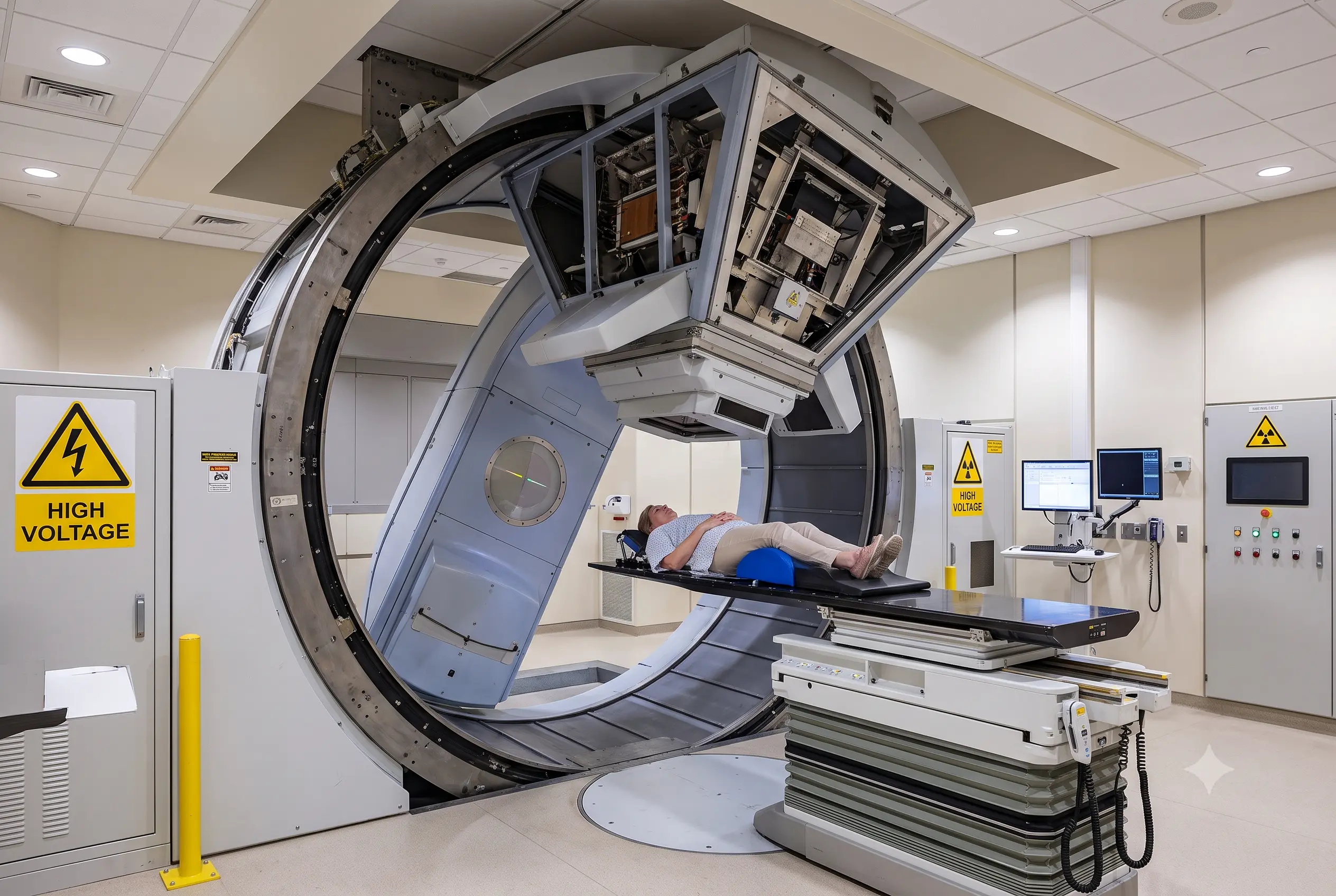
TrueBeam is a machine brand, and VMAT (Volumetric Modulated Arc Therapy) is the delivery technique it’s best known for — both are photon (X-ray) based radiotherapy. Proton therapy is a different physical process altogether: it uses charged particles that stop precisely inside the tumor, releasing most of their energy at a specific depth (the “Bragg peak”) with essentially no exit dose beyond it. Conventional X-rays keep travelling through the body after hitting the tumor, depositing radiation in healthy tissue on the far side.
Patients who tend to benefit most from proton over photon-based treatment:
- Children with cancer, of almost any type and site — this is the single strongest indication. Growing tissue is most sensitive to scatter radiation, and reducing dose to the rest of a developing body meaningfully lowers the lifetime risk of a second cancer and of growth or hormonal complications later in life.
- Brain and skull-base tumors, especially chordomas and chondrosarcomas of the skull base or spine — these tumors sit directly against the brainstem, optic nerves, and pituitary gland, and are notoriously radioresistant, often requiring doses higher than photon therapy can safely deliver to that location. Proton series have shown strong local control in exactly this group.
- Ocular tumors, including uveal melanoma and retinoblastoma in children — proton therapy can spare the lens, retina, and optic nerve enough to preserve vision in ways conventional radiation often cannot.
- Sarcomas of the spine, sacrum, and skull base — high-dose radiation is required, and protons deliver it while sparing the spinal cord.
- Tumors near the heart or lungs, including some lung and esophageal cancers — measurably lower radiation dose to the heart and healthy lung tissue, which matters most for locally advanced disease requiring higher cumulative doses.
- Prostate cancer requiring pelvic lymph node coverage — improved sparing of surrounding healthy tissue such as bowel and bladder.
- Any cancer requiring re-irradiation — if a patient was already treated with radiation in the same area once before, healthy-tissue tolerance is largely used up, and protons make a second course of treatment possible where photon retreatment often isn’t.
Where Is Proton Therapy Available Worldwide?
Proton therapy requires a building-sized cyclotron or synchrotron, so it remains far rarer than standard radiotherapy. As of 2026, availability breaks down roughly as follows:
- United States — the largest network, around 45 operational centers, concentrated in Florida, Texas, and the Northeast.
- Europe — 29 centres as of 2026, led by Germany (Heidelberg, Essen), with the UK’s two NHS centres (Manchester, London), and growing capacity in Spain, France, Italy, and the Netherlands.
- Japan and South Korea — Japan has operated particle therapy for decades and runs more than a dozen facilities.
- India — two operational centres: Apollo Proton Cancer Centre (Chennai, since 2019) and Tata Memorial Centre / ACTREC (Navi Mumbai, since 2023, India’s first public-sector facility). More are under construction in Hyderabad.
- China, Taiwan — rapidly expanding capacity as part of over 60 new particle-therapy centres being built globally.
Nowhere in the Gulf Cooperation Council (UAE, Saudi Arabia, Qatar, Kuwait, Oman, Bahrain) currently operates a proton therapy centre, despite world-class general oncology infrastructure and very high healthcare spending capacity. The same is true of the entire African continent — South Africa’s iThemba LABS pioneered proton therapy on the continent starting in 1993, but the programme closed in 2017, and a proposed revival centre at the University of Cape Town remains at the planning stage.
Proton Therapy Access, Wait Time & Cost by Country
|
Country |
Proton Available? |
Typical Wait to First Treatment |
Approx. Self-Pay Cost (USD) |
|
USA |
Yes — ~45 centers |
1–2 weeks to consult; treatment ~1–2 weeks after simulation (insurance pre-authorization can add 5–11+ days) |
$125,000 – $205,000 |
|
UK |
Yes — 2 NHS centres |
NHS: ~2–3 weeks after assessment (if accepted); private route available for others |
Free via NHS; ~$57,000–$76,000 private |
|
Germany |
Yes — 6 centres (Heidelberg, Essen lead) |
Treatment typically begins ~1–2 weeks after first appointment |
$100,000 – $150,000 |
|
Japan |
Yes — 12+ centres |
Not separately published in this research |
~$12,000–$25,000 for the proton course itself (not covered by national insurance for most cancers); higher with full hospital costs |
|
India |
Yes — 2 centres (Chennai, Mumbai) |
As little as 3 days to get on the machine once accepted |
$25,000 – $70,000 (most packages cluster $30,000–$48,000); subsidised option for Indian citizens at Tata Memorial |
|
UAE / GCC |
No |
N/A — patients travel abroad |
N/A domestically |
|
South Africa |
No (closed 2017; revival proposed) |
N/A — patients travel abroad |
N/A domestically |
If You Already Live in a Proton-Therapy Country — Why Consider India Anyway?
Patients in the US, UK, or Germany sometimes still look at India for one of three reasons:
- Cost, even with travel: A US self-pay patient facing $150,000+ can often complete treatment, flights, accommodation, and a companion’s stay in India for a fraction of that — a meaningful option for the uninsured, underinsured, or those facing high co-pays.
- Speed: NHS wait times are structured and fair but capacity-constrained (only 2 centres for the whole of England), and US insurance pre-authorization alone can add over a week before treatment even begins. India’s proton centres can get an accepted patient onto the treatment machine in as little as 3 days — a meaningful difference for anyone whose oncologist has flagged that delay carries real clinical risk.
- Second opinions and specific expertise: Apollo Proton Cancer Centre has now treated patients from 147 countries and built deep experience in specific cancer types — some patients seek it out for a particular specialist’s track record, not just price.
If You Live in the GCC or South Africa — What Are Your Realistic Options?
Patients from the Gulf and South Africa face a different problem: it isn’t cost that’s the barrier, it’s that the treatment simply doesn’t exist at home yet. Both regions have strong general hospital infrastructure and internationally accredited cancer centers — but no cyclotron.
For GCC patients specifically:
- Many employer health insurance plans in Saudi Arabia, UAE, Kuwait, and Qatar already cover treatment at JCI-accredited hospitals abroad — it’s worth checking your policy before assuming this is fully out-of-pocket.
- Geographic proximity matters: a direct flight of roughly 3–4 hours connects most Gulf cities to Chennai, Mumbai, or Delhi — far shorter than travelling to the US or Germany.
- India already has established GCC-patient infrastructure — Arabic-speaking coordinators, medical visa (Category MED) support, halal food, and prayer facilities are standard at major private hospital chains including Apollo.
For South African patients specifically:
- With iThemba LABS no longer offering clinical proton therapy, South African patients needing proton treatment currently have no domestic option and must travel — commonly to Europe, the US, or increasingly India for cost reasons.
- Direct flight connections from Johannesburg or Cape Town to Indian metros are more convenient and less visa-restrictive for many South African passport holders than routes to the US or UK.
- Cost matters here too: even with strong medical aid schemes, South African medical aid rarely fully covers treatment abroad, making India’s lower absolute cost meaningful even for well-insured patients.
Apollo Runs the Machine. Here’s What We Do.
It’s a fair question: in India, proton therapy is delivered by the hospitals themselves — Apollo Proton Cancer Centre and Tata Memorial. We don’t own a cyclotron, and we’re not pretending to. So why write to Treatment Possible instead of contacting Apollo directly?
Because a hospital’s international patient desk works for the hospital. Their job is to bring you in as a patient at that hospital — not to tell you if a different hospital, a different city, or even a different treatment might genuinely serve you better. That’s the gap we sit in:
- An independent second opinion before you commit: We can help you get your case reviewed and compare options — including whether proton is even the right call for your specific diagnosis — without the built-in incentive a single hospital’s sales team has to say yes.
- One point of contact instead of five: Between medical records, visa paperwork (Category MED), travel, accommodation for a companion, and the hospital’s own admissions process, international cancer treatment involves a lot of moving parts. We coordinate all of it so you’re not chasing five different departments while managing a cancer diagnosis.
- No cost to you, transparent process: Our coordination doesn’t add to your treatment bill — you pay the hospital directly for your care, same as you would going direct. What we add is time saved, paperwork handled, and a second set of eyes on your case before you fly.
- We’ve done this before: We work with patients from the Gulf, Africa, and beyond navigating exactly this journey — including the specific visa, travel, and logistics questions that come up again and again for patients from countries without proton therapy at home.
We’re a patient facilitator, not a hospital, and not a substitute for your treating oncologist’s medical judgment. What we offer is help getting to the right decision and the right hospital with less friction — not a clinical service Apollo itself doesn’t provide.
Before You Choose a Destination: Questions Worth Asking
- Is proton therapy actually indicated for my specific cancer type and stage — or would standard VMAT/IMRT achieve an equivalent result at lower cost and shorter travel?
- Does the receiving hospital have documented experience treating my specific cancer type, not just proton therapy in general?
- What is bundled into the quoted price — scans, hospital stay, follow-up visits — and what is billed separately?
- What visa category is required, and how long does approval typically take?
- Is a companion’s travel and stay included or separately budgeted?
- What does post-treatment follow-up look like once you’ve returned home — and who manages it?
The Bottom Line
Proton therapy is a genuinely valuable tool for a defined set of patients — not a universal upgrade over modern photon radiotherapy. For patients in capacity-constrained systems (UK, parts of the US) and for patients in countries with no proton access at all (the GCC, South Africa), India has emerged as a credible middle path: internationally accredited facilities, growing clinical experience, established international-patient logistics, and a cost structure that can be 60–80% lower than the US or Europe — without, on current evidence, a compromise in the equipment or expertise being used.
The right decision still depends entirely on individual diagnosis, staging, and what a treating oncologist recommends — this guide is a starting point for questions to ask, not a substitute for that conversation.
Have Questions About Your Specific Case?
Every cancer diagnosis is different, and this guide can’t tell you whether proton therapy is right for your specific situation. If you have a report, scan, or diagnosis you’d like reviewed or simply want to understand your options, costs, and timelines before deciding anything — write to us.
There’s no cost or obligation to reach out — we’ll help you understand whether proton therapy applies to your case, what it would involve, and what your realistic options are, in India or otherwise.